
Don't miss our Cryptocurrency offer - up to 15% OFF!

Onyx Research TB-500: thymosin beta-4 for repair research
Onyx Research TB-500 is synthetic thymosin beta-4, the actin-binding peptide studied in cell migration, wound closure and heart repair. Here’s what it is, what the research shows and how to order it.
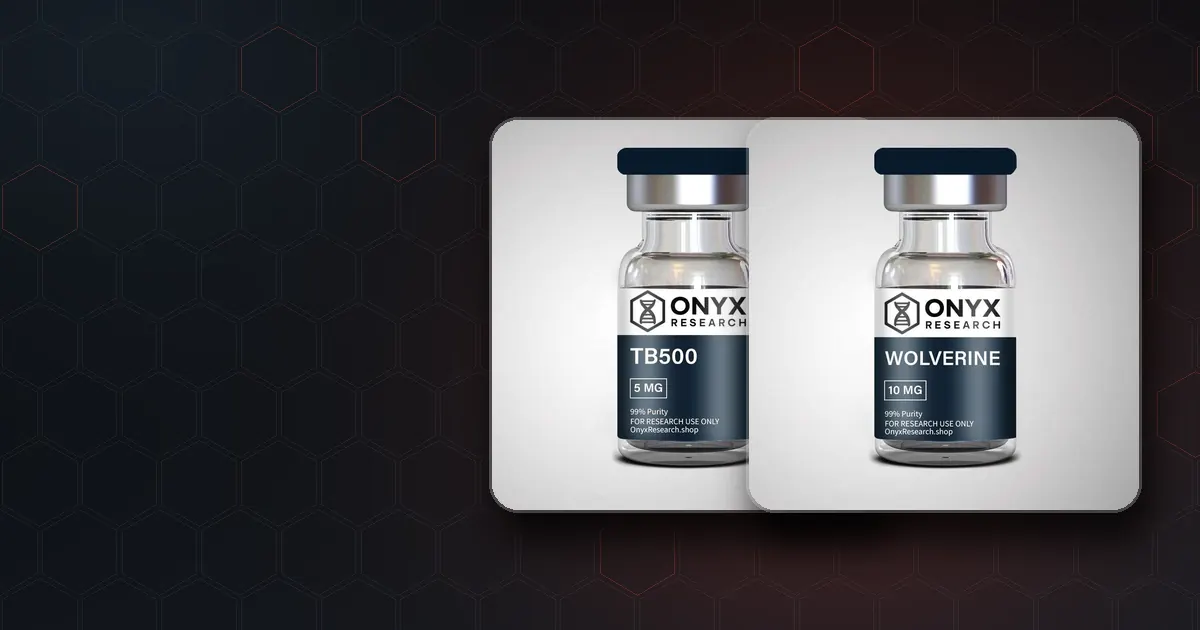
What is Onyx Research TB-500?
Onyx Research TB-500 is synthetic thymosin beta-4. The natural protein is 43 amino acids long and shows up in almost every cell, with the highest levels in platelets and white blood cells. Its day job is holding on to G-actin, the building block of the cell’s internal scaffolding, which controls how cells move and change shape.
TB-500 isn’t an approved medicine, and it’s on the WADA prohibited list. We sell it for laboratory research only.
TB-500 research highlights
Goldstein and colleagues reviewed thymosin beta-4’s role in wound repair in 2012, covering faster skin wound closure and new blood vessel growth in animal models. Bock-Marquette and colleagues reported in Nature in 2004 that it helped heart muscle cells survive after injury in mice. The PubMed search for thymosin beta-4 lists the rest.
Onyx Research TB-500 lab testing
Our TB-500 went to Freedom Diagnostics, which identified it by mass spectrometry as thymosin beta-4 and measured 99.141% purity by HPLC. The report was dated January 26, 2026, with search code Onyx2601230041. The tested batch was labeled 5mg. Check the TB-500 product page for the current vial size before you order, and email us if you need it confirmed.
TB-500 and BPC-157: the Wolverine pair
TB-500 and BPC-157 are the most common pair in repair research because they cover different steps. BPC-157 is tied to new blood vessel growth, and TB-500 to the cell migration that fills a wound. The Wolverine blend puts 5mg of each in one vial, and Freedom Diagnostics tested it at 99.72%. For the full picture, read our BPC-157 guide.
If you also want copper peptide remodeling, GLOW adds GHK-Cu, and KLOW adds GHK-Cu and KPV.
Onyx Research TB-500 options
 Wolverine Blend 10mg
 GLOW Blend 70mg
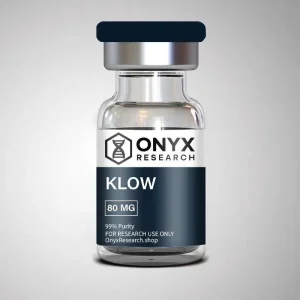 KLOW Blend 80mg
Mixing and storing TB-500
Use bacteriostatic water. Warm the vial to room temperature, add the water down the side of the glass and swirl gently. Sealed vials keep best at -20°C. A mixed vial goes in the fridge at 2 to 8°C and should be used within about 28 days.
Choosing between Onyx Research TB-500 and the blends
Onyx Research TB-500 on its own suits studies that need a clean thymosin beta-4 control or a ratio of their own design. The blends suit work that already knows it wants a combination: Wolverine for the classic pair, GLOW and KLOW when collagen remodeling or inflammation are part of the question.
Cost is another factor. A single TB-500 vial is $70, and Wolverine, with 5mg each of TB-500 and BPC-157, is $85. If you need both compounds anyway, the blend costs less than buying two vials and mixing them. If you need to vary the ratio, single vials are the only way to do it.
Whichever you choose, keep a short log of when each vial arrived and when it was mixed. Thymosin beta-4 is stable as dry powder but, like every peptide, it breaks down faster once it’s in solution.
Onyx Research TB-500 FAQ
How much does Onyx Research TB-500 cost?
The TB-500 vial is $70. The Wolverine blend, with 5mg each of TB-500 and BPC-157, is $85.
Is TB-500 the same as thymosin beta-4?
TB-500 is the research name for synthetic thymosin beta-4 and for a short fragment of its active region. Freedom Diagnostics identified our material as thymosin beta-4.
Does Onyx Research TB-500 have a lab report?
Yes. Freedom Diagnostics measured it at 99.141% purity (search code Onyx2601230041).
What do I mix TB-500 with?
Bacteriostatic water. Add it slowly and swirl, don’t shake.
Order Onyx Research TB-500
In stock and shipped free on every order. TB-500 10mg starts at $70.
Onyx Research products are sold for laboratory research use only. They aren’t for human or veterinary use and haven’t been evaluated by the FDA.